

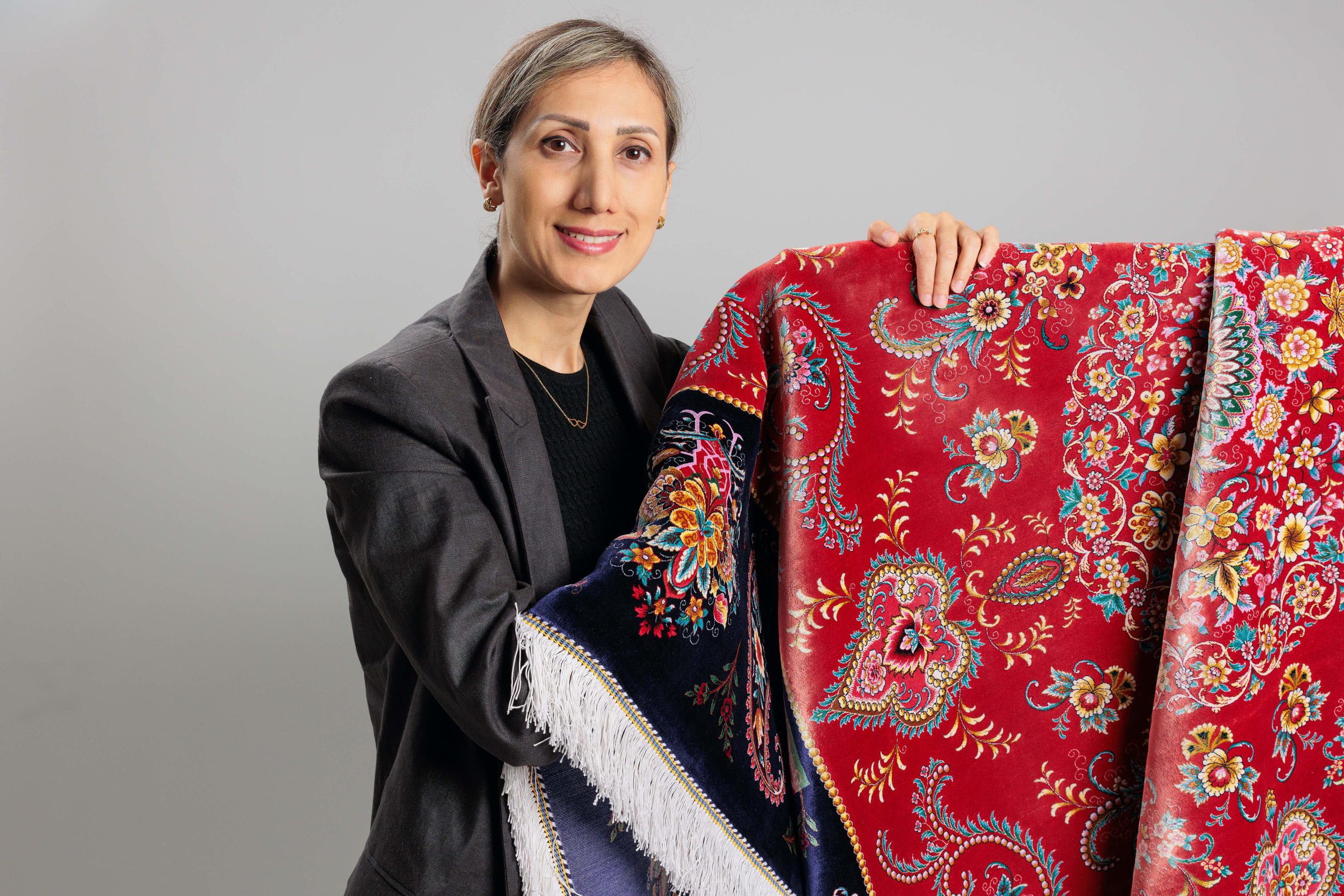
In early spring, we opened a new shop-showroom Persian Dreams at Liivalaia 40 in Tallinn, which brings genuine Persian carpets to Estonia directly from their historical region in the Middle East. The soul and hostess of our salon, Marziyeh Babari, or Mina for short, moved to Estonia with her husband a few years ago, and now an opportunity was found to bring genuine carpet art from Mina to Estonian homes.
Estonians are probably first associated with the Persian carpet as a large red decorative element, often attached to the walls. The hostess of the salon shows the different styles, materials, patterns and colors used in authentic Persian rugs. The color selection includes, so to speak, the classic Persian red, as well as carpets with softer tones, which include yellow-gold, mint green, light blue and even pink threads.
The desire for freedom brought Estonia
My husband and I heard about Estonia from our relatives, and we visited Tallinn for the first time in July 2022, when it was a beautiful summer outside, and we immediately had the idea to move here more permanently. “It is no secret that the situation in my country is extremely difficult. I do not like the political regime and restrictions in my home country and want to live in a free society where there is no government imposition of religion and women’s rights are not restricted. For me, culture and the current regime of the homeland are different things. When we had spent only a month in Estonia, we already understood that the people and society here are something very special. We also had other options, but Estonia quickly won our hearts”, describes Mina’s first impressions. “But of course, when we came here to settle permanently, a few months later in October, the weather was already a completely different situation that needed some getting used to.” (laughing – ed.)
It turns out that the freedom to create and develop a company is not self-evident everywhere in the world, and creating and managing a business was a new challenge for the former director of the English Institute located in the capital of his country with almost 20 years of experience: “Estonian homes inspired the creation of Persian Dreams. Whereas it is something very European and a bit humorous for us when we moved here, that all the rooms of our home are shown and presented to the guests. It’s not customary in my culture, but it’s very nice that people show their favorite place with pride. It was this that inspired us to bring genuine Persian carpets to Estonia”, describes the woman, who noticed a lot of empty surfaces in the homes and little use of patterns. In addition, the low use of carpets in homes and their function more as a decorative element than as a practical home furnishing item also stood out.
Mina explains how rugs have a different function in the Middle East, of course. The walls are covered with carpets, they are everywhere on the floor for walking, sitting and resting. They are integrated in all rooms and create a cozy environment. In Estonian homes, carpets already have outputs with a slightly different emphasis due to the climate. “Rugs are objects that bring warmth, coziness, softness and color to your most important environment. Persian rugs store and retain heat, which is very important in cooler climates. In addition, like any textile, carpets also reduce echoes and make our homes cozier, so carpets are both a practical and beautiful furnishing element”, she points out the functional and aesthetic properties of carpets.
What is the difference between a rug and a Persian rug?
Weaving carpets is nothing new to Estonians either. Carpets have been woven on looms for centuries, and hints of the creation of the first carpets in the world go back 6,000 years. “The oldest preserved carpet is about 4,000 years old, and most of the researchers confirm that it is precisely a Persian carpet. This is not a coincidence. Carpet art is something that has been passed down from generation to generation for millennia. It’s like a language, and the creation of carpet art has nothing to do with politics or religion – craftsmanship is much older than that,” says Mina.
Mina tells how the first Persian carpets reached Europe thanks to the conquests of Alexander the Great and the skill of carpet weaving during the Moorish conquests in the 10th century and during the first Crusades, when returning knights brought Persian carpets back home. “Today, carpets are very popular, of course, in the countries along the Persian Gulf and the Caspian Sea, but also, for example, in Japan, the USA and Germany,” Mina describes. “As an interesting fact, I would like to mention that despite the situation where, for example, the countries of the Arabian Peninsula also produce carpets themselves, carpets are still bought from Iran by rich oil sheikhs and even sultans for important buildings, for example. The best example is located in Masquat, the capital of Oman, where the world’s largest Persian carpet is located in the Sultan Qaboos Mosque on the Arabian Peninsula”.
The main difference between Persian and Persian-style rugs is the region of origin, colors and technique. “Persian carpets are part of the UNESCO cultural heritage list, and they have specific color tones, which are surprisingly numerous. In addition, there is a certain technique that is passed down from generation to generation and a skill that is easily noticeable in imitations.”
Mina points to the carpet and points out that in the case of carpets, they talk about the density of the yarns: “In Persian carpets, they talk about the density based on knots. While imitations usually have 5 knots per square centimeter, authentic carpets have 15 or more, meaning they are dense, durable and rich in detail. Of course, this is also a more time-consuming job. Based on the density of the carpet, it is quite easy to distinguish whether it is a genuine Persian carpet or a Persian-style carpet made in, for example, Turkey, China or India. Also, they generally don’t use the right materials, like silk and acrylic, so the rugs lack luster and pill quickly.”
Luxury or not
For an Estonian, the words silk and weaving immediately create the feeling that it is an expensive luxury product, but this is quickly refuted by Mina: “Considering that in our region, imitations are sold quite expensively due to the shortage of originals, a genuine Persian carpet is actually practical and affordable. Especially since we use silk and acrylic as materials, which ensure durability and are also suitable for allergy sufferers.” By using silk, wool, acrylic and their combination, Persian carpets also achieve a luster that can only be seen with the naked eye and is difficult to capture in a photo.
A unique and perfect Persian rug for your home
In addition to the products, the Tallinn Persian Dreams salon also has sample models and catalogs, on the basis of which you can order a carpet of the color scheme, pattern and size that suits you. “It takes about three weeks to order a carpet designed to your liking, and the carpets come directly from the manufacturer. Of course, you can take home the products on site right away.”
The most important thing for Mina is seeing and touching the carpets on site and experiencing their beauty. “We live in an age where we design our homes and living spaces on screens with Pinterest and moodboards, but a Persian rug is something you have to see and feel for yourself.”
If home furnishing or updating is planned, Mina recommends taking the dominant colors of the room, e.g. in the case of the living room, the color of the sofa, curtains and walls are generally in harmony, which can be carried forward by the Persian rug. “We have experience of bringing softness and beauty to the children’s room, because the selection of colors includes, for example, light pink and blue, which are perfect for the children’s room. Since many Estonians also have country houses and summer houses, yellowish and light gray tones are suitable for them, which bring brightness to the white summer days.”
Mina shows the different carpets that are available in the Liivalaia salon. Among them are the well-known and well-known red Persian as well as deep blue carpets that resemble the depths of the ocean. Brighter yellowish and aqua gray carpets give a completely different feeling and create spaciousness in the room. “Look at how easy it is to roll and fold, for example, silk carpets. They are really light and there is no crease.”
Mina also gives some tips to keep in mind when choosing a carpet, so that the result is perfect:
- Think about the size of the carpet and consider how much surface it should cover;
- What are the main color tones of the room and should the carpet create a contrast or continue the color scheme;
- What mood and feeling should the carpet convey – whether it is a carpet for a children’s room, study, dining room, corridor or living room, for example;
Regardless of whether it gets a lot of daily traffic or a little, Persian rugs are very durable and their beauty lasts for decades. Since many homes in Estonia also have underfloor heating, Persian carpets are perfect for it. In winter, carpets retain heat, making homes even cozier. You also don’t have to be afraid to clean them with a vacuum cleaner, and it is recommended to have the carpet washed every few years by a carpet care company in order to prolong the appearance.
Future plans
Mina definitely sees her future in Estonia, and after the opening of the first salon, the following thoughts on how to develop Persian Dreams have already arisen. “Of course, we are waiting for everyone to see these carpets with their own eyes and get to know us first. I am there a lot myself, and although I am still learning Estonian, at least I can answer all questions in English. The feedback so far has been very positive, and I see genuine surprise in people’s eyes when they see a real Persian carpet for the first time.”
Regarding the future, Mina is currently thinking about how to bring even more oriental home furnishing elements to Estonia. At the moment, tableware is in mind, incl. silver and copper, curtains and other decorative items. And as previously mentioned, Mina is always ready, at the moment unfortunately still in English, to give advice on how to find a practical and aesthetic genuine Persian carpet that matches the interior of your home.
 English
  Eesti
Eesti  Русский
  Suomi
Suomi  Svenska
  Deutsch
  Français
  Polski
  Dansk
Dansk  Norsk bokmål
  Nederlands
  Latviešu valoda
  Lietuvių kalba
  Italiano
  Español
  English (UK)
No comment